

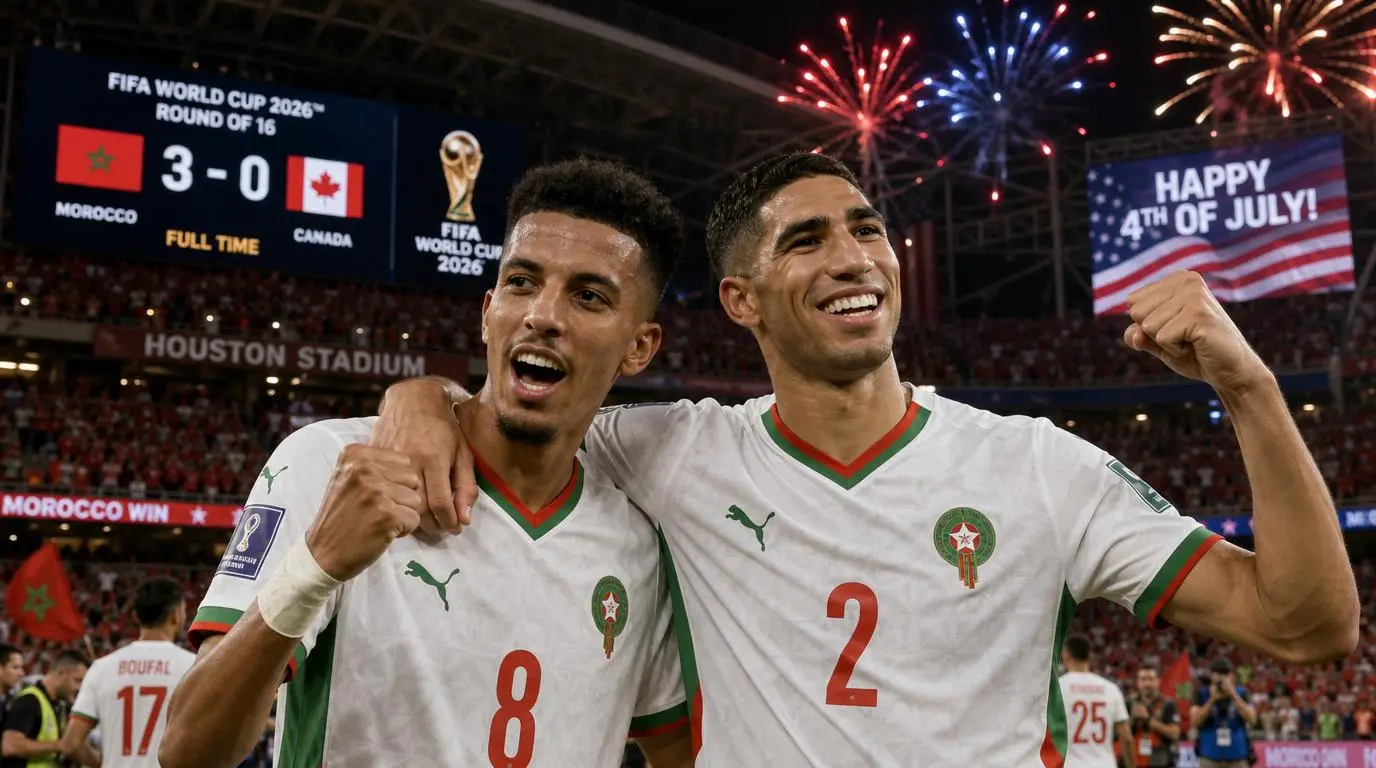
Morocco World Cup 2026 quarterfinal dream is alive and real. In a clinical second-half performance at Houston Stadium on July 4 — America’s Independence Day and the 250th anniversary of the nation — the Atlas Lions dismantled co-hosts Canada 3-0 to advance to their second consecutive World Cup quarterfinal. Azzedine Ounahi scored twice, Brahim Diaz provided a record fourth World Cup assist, and Soufiane Rahimi sealed it deep in stoppage time. Canada’s historic home tournament is over.
The Morocco World Cup 2026 victory was not built on dominance — it was built on clinical execution at exactly the right moments. With just five shots all match, Morocco became the team with the fewest shots by a winning side in World Cup knockout football since records began in 1966. They did not need more. Every opportunity they created, they finished.
Morocco World Cup 2026: How the Match Unfolded
The first half belonged entirely to Canada. Jesse Marsch’s side pressed with relentless energy, pinning Morocco back inside their own half for long stretches and generating the match’s best early chances. Tani Oluwaseyi had the clearest opportunity, turning brilliantly inside the box before firing a low shot that Yassine Bounou — the Montreal-born Moroccan goalkeeper — turned aside with his leg in an athletically extraordinary save.
Stephen Eustaquio’s delivery on set pieces caused Morocco genuine problems throughout the first 45 minutes, and Canadian defender Luc de Fougerolles was imperious in the air on corners. The halftime scoreline of 0-0 reflected a contest where Canada had been the better team but failed to convert their pressure into a goal.
The second half was a completely different game.
Ounahi’s Brace: The Goals That Ended Canada’s Dream
The 50th minute changed everything. Achraf Hakimi cut back a free kick precisely into the path of Azzedine Ounahi, who spun a low ball through a crowd of bodies — and through a teammate’s legs — to beat Maxime Crepeau at his near post. The goal felt against the run of play, but that is the cruel mathematics of knockout football. Morocco led 1-0, and Canada’s composure visibly fractured.
Morocco ultimately produced an xG of 0.85 compared to Canada’s 0.78, indicating a tight contest that ended with a slightly skewed scoreline. ESPN
Ounahi completed his brace in the 82nd minute with an equally composed finish, capitalizing on Canada’s stretched defensive shape as Marsch’s side pushed desperately for an equalizer. Brahim Diaz — magnificent throughout the second half — laid the ball perfectly into Ounahi’s path, and the Girona midfielder made no mistake.
Then, deep into eight minutes of added time, Diaz turned provider one final time, releasing Soufiane Rahimi — who had replaced the injured Ismael Saibari before halftime — into space behind Canada’s defense. Rahimi’s low finish into the bottom-right corner completed the rout at 3-0 and confirmed one of the most decisive scorelines of any World Cup knockout match this tournament.
Brahim Diaz: Record-Breaker in Texas
The individual story of the Morocco World Cup 2026 victory was Brahim Diaz. The AC Milan attacking midfielder finished the match with two assists, taking his total to four for the tournament — a new African record for World Cup assists. His movement, intelligence, and ability to unlock defensive structures in the second half were the defining technical contributions to Morocco’s victory, even as Ounahi claimed the headlines with his goals.
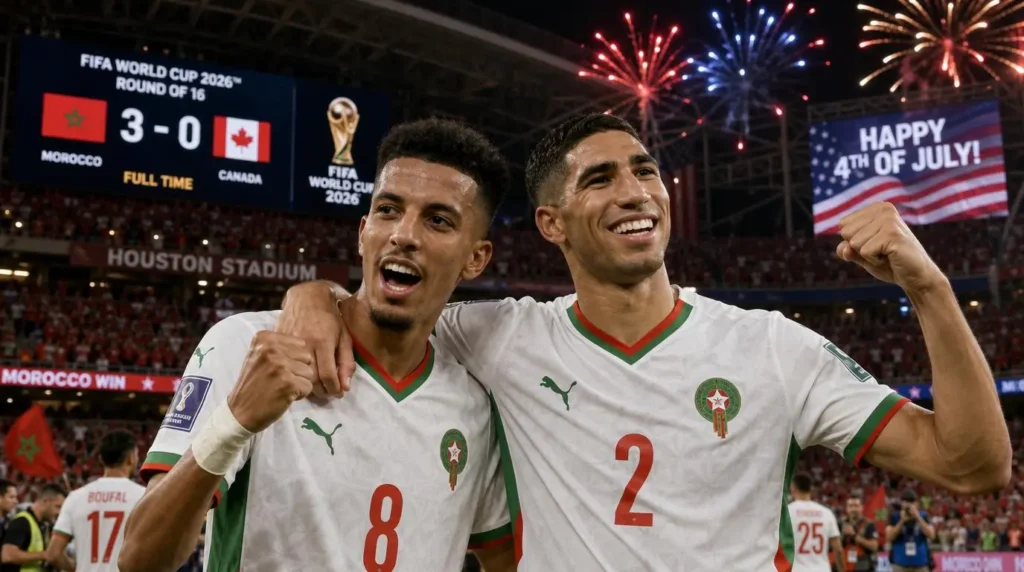
Diaz’s partnership with Hakimi on Morocco’s right side was the axis around which the Atlas Lions’ second-half dominance was built. Canada had no answer for the combination’s pace, technique, and willingness to run in behind.
Saibari’s Injury: A Shadow Over Morocco’s Triumph
Morocco’s only significant concern from the day was the first-half injury to Ismael Saibari, the newly-transferred Bayern Munich forward who had been one of the tournament’s standout players. Saibari — the only player alongside Lionel Messi to score in each group-stage match — was forced off with a hamstring injury in the 21st minute, replaced by Rahimi.
Whether Saibari can recover in time for the quarterfinals, scheduled for July 9 in Boston, will be the central medical question for Morocco’s coaching staff in the coming days. His loss is significant: Saibari’s combination of pace, pressing intensity, and clinical finishing made him Morocco’s most unpredictable attacking weapon.
Davies Missing Again: Canada’s Bitter Ending
Canada’s day was defined not only by the defeat but by a painful injury subplot. Captain Alphonso Davies — who had only just returned from a hamstring problem to make his tournament debut as a substitute against South Africa in the Round of 32 — did not feature on the day his country needed him most. Coach Jesse Marsch confirmed after the match that Davies’s hamstring “didn’t feel right” at training on Thursday, and an MRI showed no structural damage, but the Bayern Munich star was unavailable.
Davies played just 15 minutes of Canada’s entire World Cup campaign. That reality — a generational talent, his country’s best player, sidelined by injury for 95% of a home World Cup — is perhaps the most heartbreaking individual storyline of Canada’s tournament.
Canada’s Legacy: The Best World Cup in Their History
Despite the 3-0 defeat, Canada exits the 2026 World Cup with the most successful tournament in their men’s national team history. They won their group for the first time. They advanced out of the group stage for the first time. They reached the Round of 16 for the first time. And they did it as co-hosts, in front of home crowds that generated an atmosphere that has left a lasting impression on everyone who witnessed it.
Canadian Prime Minister Mark Carney was immediate and gracious in defeat. “Nothing but pride for our team today,” Carney posted on social media. “An incredible run and a sign of what’s to come.”
Coach Jesse Marsch acknowledged the missed opportunities while refusing to diminish what his squad achieved. His side controlled the first half. They simply could not finish when it mattered — and Morocco punished them with ruthless efficiency when the momentum shifted.
What Comes Next: Morocco vs. France or Paraguay
Morocco advances to the quarterfinals, where they will face the winner of Friday’s Round of 16 match between France and Paraguay in Boston on July 9. The prospect of a Morocco-France quarterfinal rematch — a replay of the 2022 Qatar World Cup semifinal, which France won 2-0 — is the tie that would generate the most global interest and the most emotional resonance for the Atlas Lions.
For Morocco, their 2026 campaign represents a continuation of what began in Qatar four years ago: a program that has now reached back-to-back World Cup quarterfinals, playing a style of football that is tactically sophisticated, physically demanding, and increasingly confident on the game’s biggest stage.
Their journey in 2026 is not over yet.