

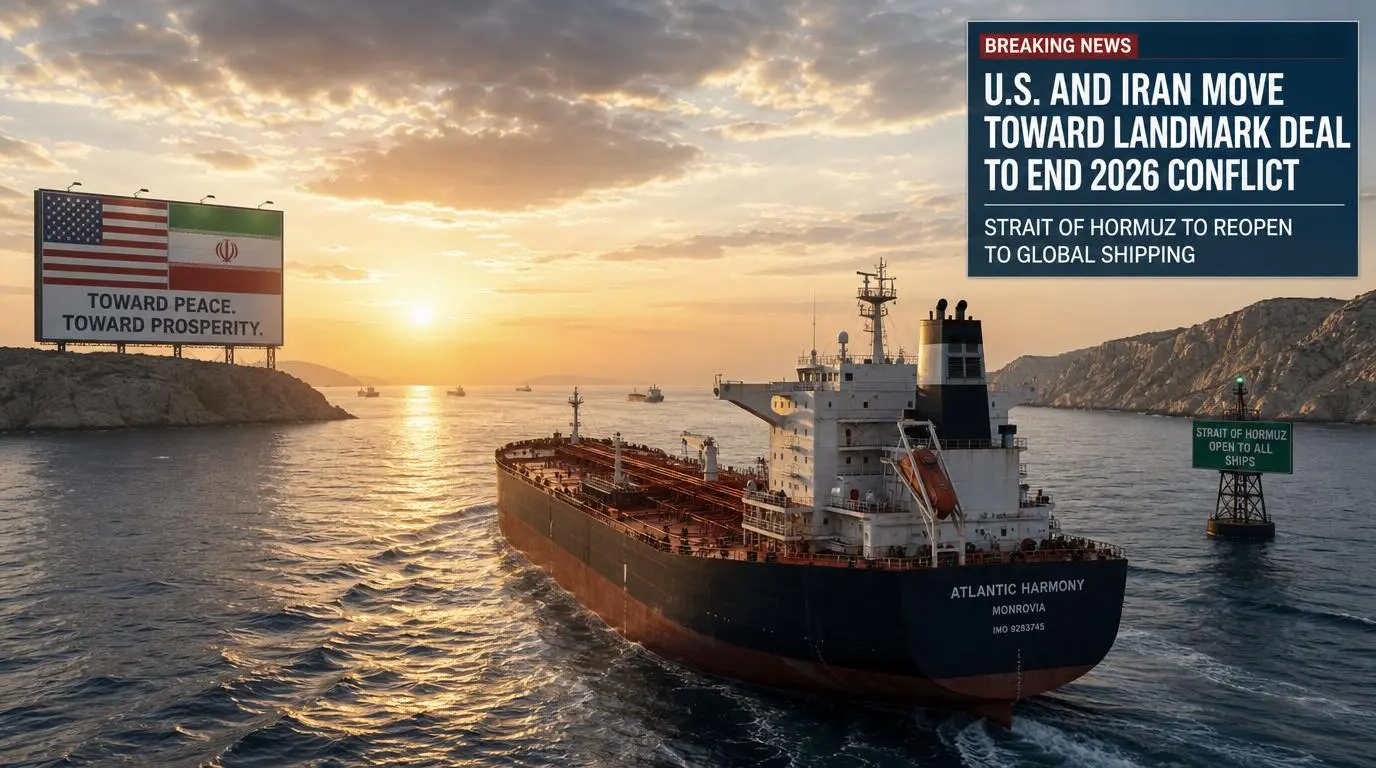
Trump Iran deal ended war 2026 — those five words are ricocheting across America right now. On Friday, June 12, President Donald Trump stood before supporters at a telerally for the Georgia governor’s race and made the most dramatic foreign policy announcement of his second term: “We ended the war in Iran today.” Hours earlier, speaking in the Oval Office, Trump had said a deal with Iran could be signed “maybe over the weekend, in Europe,” and that Vice President JD Vance would take part in the signing ceremony.
If the deal holds, the Trump Iran deal ended war 2026 moment will mark the end of nearly four months of conflict that drove oil prices to painful highs, rattled global financial markets, and squeezed the budgets of tens of millions of ordinary American families at the gas pump and the grocery store.
What Trump Actually Said — and What It Means
The sequence of statements on Friday was extraordinary in its public confidence. In the Oval Office, Trump told reporters that Iran’s supreme leader had personally approved the deal framework — a claim Iran’s foreign ministry had not yet confirmed publicly, though state-affiliated Iranian media reported that Tehran had “not yet reached a final decision.”
“We ended the war in Iran today,” Trump said at the Georgia telerally. It was not a formal announcement. There was no joint press conference, no signed document shown to the cameras, no State Department briefing. But for an administration that has consistently used public declarations to shape diplomatic reality, the statement carries enormous weight.
According to reporting by The New York Times, the deal framework calls for an immediate cessation of hostilities, the reopening of the Strait of Hormuz to commercial shipping within days, and a 30-to-60-day negotiating window for a new framework agreement on Iran’s nuclear program. Trump said the signing could happen “in Europe” this weekend, with Vance representing the United States at the ceremony.
The Iranian foreign ministry spokesperson Esmaeil Baghaei said Friday that Iran had not reached a final decision, according to Iranian state media — a standard diplomatic hedge that does not necessarily contradict Trump’s claim. Final deals in complex negotiations are often announced before all paperwork is complete.
Why This Is the Biggest Economic News of 2026
For American consumers, the Trump Iran deal ended war 2026 announcement is primarily an economic story. The Strait of Hormuz carries approximately 20% of the world’s traded oil. Since its effective closure in late February, that disruption has cascaded through global energy markets with predictable and painful results.
Gasoline prices at American pumps climbed to multi-year highs. Diesel surcharges drove up the cost of shipping, which increased the price of virtually everything Americans buy. Airline tickets rose. Heating and cooling costs climbed. The Federal Reserve, which had been on track to cut interest rates, held back partly because energy inflation kept overall price pressures elevated.
When a preliminary ceasefire was announced in April, Brent crude fell nearly 16% in a single session. A final, signed deal would likely produce a similar or larger reaction — potentially the most significant single-day relief for American consumers since the early months of the pandemic ended in 2021.
As Reuters reported, crude oil futures retreated Friday morning in anticipation of the announcement, and financial markets broadly moved higher as the probability of a signed deal increased.
The Road That Led Here
The path to the Trump Iran deal ended war 2026 moment ran through some of the most dramatic diplomatic episodes of the year. In early June, Trump made international headlines when he confirmed telling Israeli Prime Minister Netanyahu “Are you f***ing crazy?” during a heated phone call — a call that stopped planned Israeli airstrikes on Beirut that would have derailed the Iran negotiations entirely.
The administration spent months working through Omani, Qatari, and European intermediaries to find a framework that satisfied Tehran’s core demand for sanctions relief while meeting Washington’s insistence on nuclear verification mechanisms. The talks came close to collapse multiple times — most recently when Israel’s Beirut evacuation warnings caused Iran to suspend its participation.
The fact that a deal is now apparently within hours of signing — after all of that — represents a genuine diplomatic achievement, whatever one thinks of the Trump administration’s methods.
What JD Vance’s Role Means
Trump’s statement that JD Vance would attend the European signing ceremony is significant. It elevates what could have been a lower-level diplomatic event into something with the weight of a vice presidential presence — and it gives Vance, who has been positioning himself as a key foreign policy voice in the administration, a historic moment on the world stage.
It also provides Trump himself with a convenient separation. By having Vance sign rather than attending himself, Trump maintains flexibility — if the deal faces domestic criticism or implementation problems, he has some distance from the ceremony itself.
The Midterm Calculation
The timing of the deal — June 12, 2026 — is not politically neutral. November’s midterm elections are less than five months away. The two issues that have consistently topped voter concern surveys this cycle are inflation and the cost of living. A signed deal that reopens the Strait of Hormuz, triggers a significant drop in oil prices, and allows the Federal Reserve to cut interest rates would be the most powerful economic argument the Republican Party could bring to the 2026 midterm ballot.
Gas prices that fall noticeably in June, July, and August — the peak driving season — would be felt in every congressional district in America. For Republican candidates defending seats in competitive districts, a peace deal in the Middle East that lowers prices at the pump is exactly the kind of concrete, tangible economic win that changes voter behavior.
Democrats have been building their midterm message around the “Accountability Summer” campaign, focused on the Big Beautiful Bill’s Medicaid cuts and their impact on vulnerable Americans. A significant decline in gas prices would not eliminate that message — but it would complicate it considerably.
What Happens If the Deal Falls Apart
Iran’s public hedging — the foreign ministry’s statement that no final decision had been reached — is a reminder that this deal is not yet signed. Diplomatic negotiations have a way of collapsing in the final hours, when the hardest issues remain and the pressure to compromise is at its most intense.
If the deal falls apart this weekend, the consequences would be significant. Markets that have already priced in a partial probability of a deal would react negatively. Trump’s public declaration that “we ended the war” would become an embarrassment with real political costs. The military and economic pressures that have been building for months would intensify.
The administration appears to have calculated that public confidence — even before the paperwork is complete — accelerates Iranian decision-making by making the deal feel inevitable. Whether that gamble pays off will become clear by the time the World Cup kicks off tonight in Los Angeles.
Follow all breaking news on the US-Iran deal and its impact on the American economy at TredScoop360.com. Read our earlier coverage: Trump Netanyahu explosive Lebanon call and US-Iran Strait of Hormuz deal explained for full context on this historic moment.
More From TredScoop360
- World Cup 2026 Opening Day Recap: 3 Shocking Red Cards, Mexico Wins 2-0, USA Faces Paraguay Tonight
- California Governor Race 2026: Becerra vs Hilton Advance — 3 Alarming Things This Tells Us About November
- USMNT Loses 2-1 to Germany in Final World Cup 2026 Warmup — 3 Alarming Lessons for Pochettino