

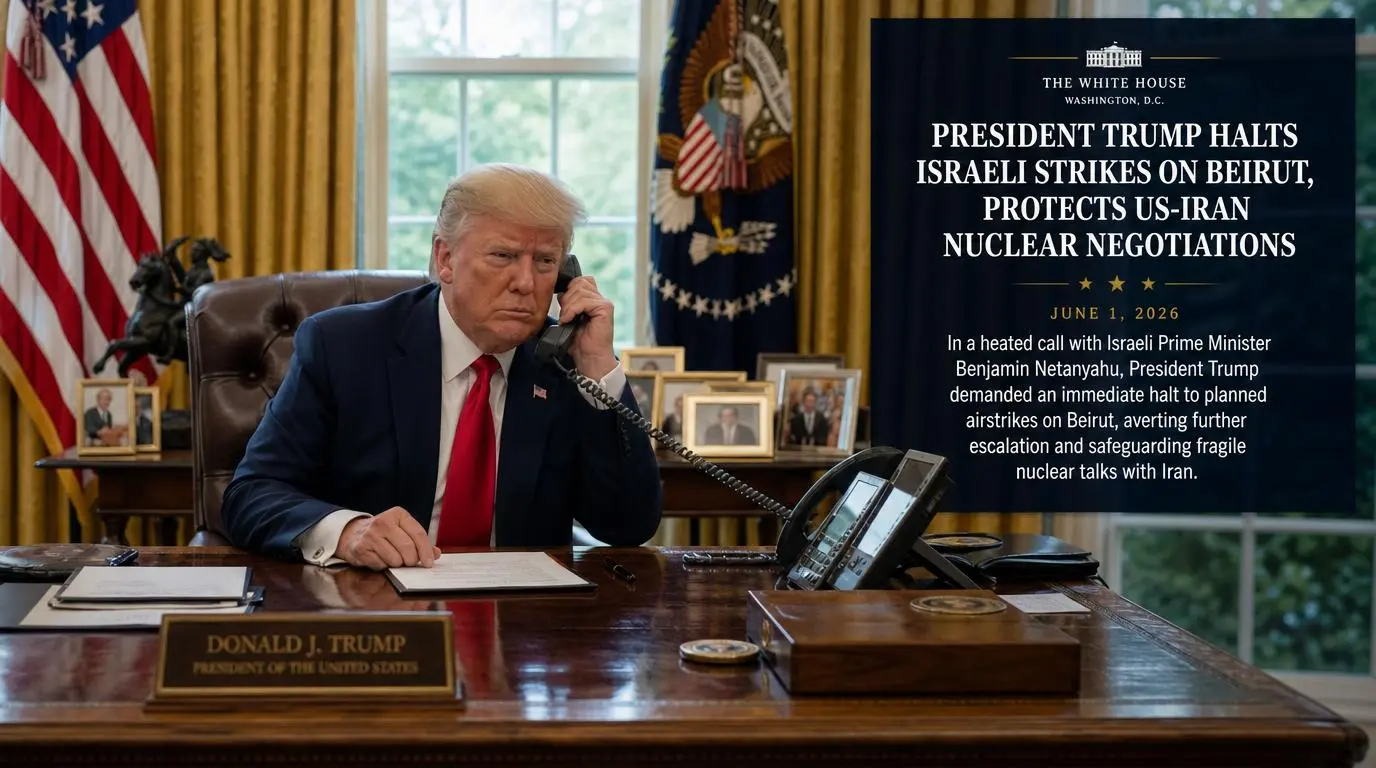
Trump Netanyahu Lebanon call 2026 is the most explosive diplomatic revelation of the year. On Wednesday, President Donald Trump confirmed what sources had been leaking for 48 hours: that he told Israeli Prime Minister Benjamin Netanyahu “Are you f***ing crazy?” during a heated phone call on June 1 — a call that stopped Israel from launching massive airstrikes on Beirut and may have saved the fragile US-Iran negotiations from total collapse.
“I did,” Trump told the New York Post when asked directly whether he used that language with Netanyahu. “I was a little bit perturbed at his constantly fighting with Lebanon.”
That is one way to put it.
What Happened: The Call That Changed Everything
The sequence of events leading to the most extraordinary public admission in recent American diplomatic history began on the morning of June 1, when the Israeli military issued an Arabic-language statement urging “all residents of the Dahieh district in Beirut to relocate for their safety.” It was the clearest possible signal that massive airstrikes on Hezbollah’s Beirut stronghold were imminent.
The prospect sent alarm bells ringing in Washington. The Trump administration had spent weeks trying to thread an almost impossible diplomatic needle: supporting Israel’s right to defend itself against Hezbollah rocket attacks while simultaneously negotiating with Iran toward a ceasefire and nuclear framework deal. A full-scale Israeli assault on Beirut would almost certainly blow up those negotiations — and with them, any prospect of ending a war that has sent oil prices surging and pushed the American economy to the edge.
According to two US officials who spoke to Axios — accounts now confirmed by Trump himself — the president called Netanyahu around noon on June 1 and did not mince words.
“What the f**k are you doing?” Trump reportedly said at one point during the call, according to a source briefed on the conversation. He told Netanyahu the escalation in Lebanon was “disproportionate,” objected specifically to Israel’s practice of demolishing entire buildings to eliminate single Hezbollah commanders, and expressed deep concern about civilian casualties.
Most critically, according to the same sources, Trump told Netanyahu: “You’d be in prison if it weren’t for me. I’m saving your ass. Everybody hates you now. Everybody hates Israel because of this.”
After the call, Israel canceled its planned Beirut strikes.
Trump Confirms It — On the Record
What makes this story genuinely unprecedented is not the content of the call — heated diplomatic exchanges between US presidents and Israeli prime ministers are not new — but the fact that Trump confirmed it publicly and apparently without regret.
In a New York Post interview published Wednesday, Trump was asked directly: “You said, ‘Are you fing crazy? What are you fing doing? I helped you stay out of jail.’ Is that true? Did you speak to him in those terms?”
Trump’s answer: “I did.”
He added context, explaining that he told Netanyahu “Bibi, we gotta stop this” and that his frustration was driven by a genuine strategic concern: Netanyahu’s escalation in Lebanon was threatening to derail the Iran negotiations that Trump has made a centerpiece of his foreign policy.
“I had a very productive call with Prime Minister Bibi Netanyahu, of Israel, and there will be no Troops going to Beirut,” Trump wrote on Truth Social after the call — a statement that was technically accurate but considerably more diplomatic than the actual conversation that had just taken place.
Why Lebanon Is Threatening the Iran Deal
To understand why Trump was “pissed” — the word used by one US official to describe his mood before the Netanyahu call — it is necessary to understand the stakes of the Iran negotiations.
According to CNN, the Trump administration has released approximately 58 million barrels of oil from America’s Strategic Petroleum Reserve — about 14% of total reserves — in an attempt to ease the supply crisis caused by the Strait of Hormuz conflict. The SPR now sits at its lowest level since January 2024. The pressure to reach a deal with Iran and reopen the strait is not abstract. It is measured in gasoline prices at every pump in America.
A US-Iran memorandum of understanding was reportedly close to completion before this week’s Lebanon escalation. The framework calls for a ceasefire, a reopening of the Strait of Hormuz, and a new round of nuclear talks. Iran had signaled its willingness to engage. Then Netanyahu ordered the Beirut evacuation warnings, and Tehran suspended its participation in the negotiations.
Trump’s call to Netanyahu was, in this context, not just diplomatic frustration. It was a direct attempt to prevent his most significant foreign policy achievement from being destroyed by an ally.
After the call, Trump posted that Iran talks were “continuing, at a rapid pace.” Qatar — which has been playing a crucial backchannel role between Washington and Tehran — worked through the weekend and Monday to push for de-escalation and help preserve the nominal ceasefire.
As of Wednesday, the situation in Lebanon remains volatile. Israeli operations in southern Lebanon are continuing. Hezbollah drones and missiles are still being fired into Israel. But Beirut has not been bombed. And for now, the Iran talks are alive.
The Relationship Between Trump and Netanyahu: Complicated
The public confirmation of Trump’s language toward Netanyahu has forced a reappraisal of one of the most discussed relationships in global politics.
Trump and Netanyahu have been publicly aligned throughout Trump’s return to office. Israel received strong US backing for its operations in Gaza and Lebanon in the early months of the administration. Trump’s team helped secure acquittal for Netanyahu in his corruption trial — a fact that Trump apparently referenced directly in the June 1 call, according to US officials.
But the two leaders have had several tense exchanges since Trump returned to office, and this week’s confrontation was described by one official as “one of Trump’s worst calls with Netanyahu since he returned to office.”
The dynamic reveals the limits of the Trump-Netanyahu relationship. Trump’s primary objective is a deal with Iran. Netanyahu’s primary objective is the destruction of Hezbollah and the prevention of Iranian nuclear capability. Those goals are not perfectly aligned — and when they conflict, as they did this week, the confrontation can be explosive.
Trump described both himself and Netanyahu as “leaders operating in wartime circumstances” and maintained that cooperation between Washington and Jerusalem remained intact. Netanyahu’s office did not respond to a request for comment on the specifics of the call.
What It Means for American Foreign Policy
The Trump-Netanyahu confrontation is a window into the enormous complexity of American foreign policy in the Middle East in 2026.
The United States is simultaneously trying to: end a war with Iran that has disrupted global energy markets; support Israel against Hezbollah while restraining Israeli escalation; manage Lebanon’s political situation; prevent a broader regional conflagration; and bring down gas prices before November’s midterm elections.
Those objectives pull in different directions. And as this week showed, even the closest alliance relationships can fracture under that kind of pressure.
For American voters watching their gas prices and their 401(k)s, the question is simpler: is Trump’s approach working? He stopped the Beirut strikes. The Iran talks are continuing. Oil prices ticked lower on Wednesday after the news of Israel’s canceled attack. Whether those results hold — and whether a final deal with Iran materializes — will determine how this extraordinary week is ultimately judged.
Trump said he told Netanyahu “Bibi, we gotta stop this.” For now, they have. What comes next is anyone’s guess.
For all breaking news on the US-Iran deal, the Middle East crisis, and American foreign policy in 2026, follow TredScoop360.com. Read our earlier coverage of the US-Iran Strait of Hormuz deal and Trump’s stock trades controversy for full context on the Trump administration’s most consequential decisions.
More From TredScoop360
- ACM Awards 2026: Cody Johnson Wins Entertainer of the Year, Ella Langley Breaks Records
- Nvidia RTX Spark 2026 Shocks Computex: A $5 Trillion AI PC Revolution That Kills Intel
- 205 Dead: US Military Drug Boat Strikes in Pacific Spark National Outrage in 2026