

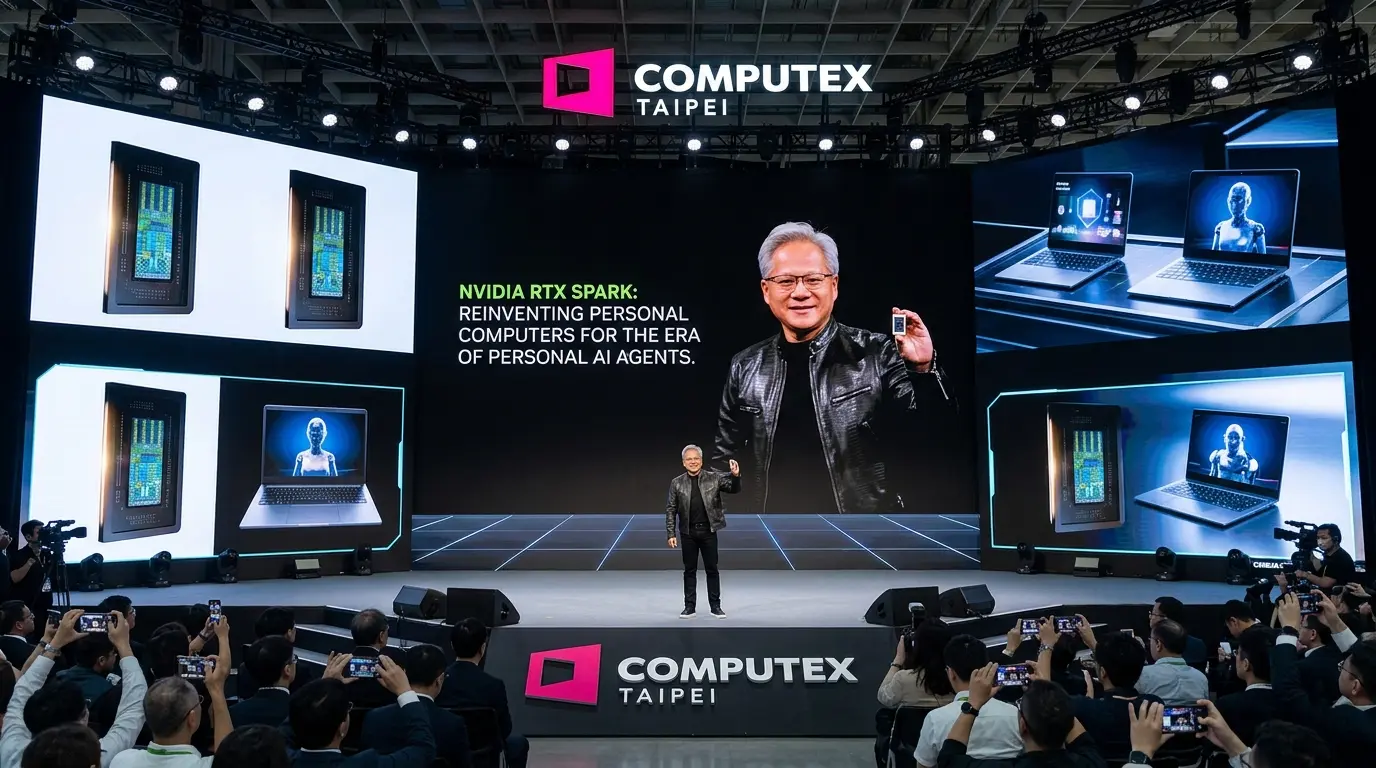
Nvidia RTX Spark 2026 just changed the personal computer forever. At a packed keynote in Taipei on Monday, Nvidia CEO Jensen Huang took the stage at Computex 2026 and unveiled a chip that Wall Street, Silicon Valley, and every tech consumer on the planet had been waiting for. The RTX Spark is not an upgrade. It is a reinvention — and it sent Nvidia’s stock surging 6% to push the company’s market capitalization past $5 trillion for the first time in history.
Intel fell 5% on the same day. That one sentence tells you everything you need to know about what just happened.
Nvidia RTX Spark 2026: What It Is and Why It Matters
The Nvidia RTX Spark 2026 is what the company calls a “superchip for the era of personal AI agents.” It pairs a Blackwell GPU with an Arm-based CPU and up to 128GB of unified memory, delivering roughly one petaflop of AI performance on the desktop or in a slim laptop. To put that in context: a standard laptop today ships with 16GB of memory. The top-of-the-line MacBook Pro can be configured with 128GB — but that costs $5,099.
Nvidia has not announced pricing for RTX Spark-powered laptops, but confirmed the first systems will target the premium market, with lower-powered, more affordable versions to follow.
“This reinvention of the computer is as big of a deal as the reinvention of the phone into what we now know as the smartphone,” Huang told delegates at the Taipei keynote. The comparison is deliberate and significant. When smartphones replaced feature phones, the companies that saw it coming — Apple, Google, Qualcomm — won. The companies that didn’t lost everything. Huang is making the same bet on AI PCs, and he is backing it with the most powerful consumer chip ever built.
The Partners Already On Board
The Nvidia RTX Spark 2026 will not be a solo venture. Huang confirmed partnerships with the biggest names in PC manufacturing: Asus, Dell, HP, Lenovo, and Microsoft Surface will all ship RTX Spark-powered machines when they reach shelves this autumn. Acer and Gigabyte are expected to follow shortly after.
Dell and HP shares both reacted immediately and positively to the announcement. Dell rose more than 10% and HP jumped 8% on Monday — both companies clearly benefiting from the association with Nvidia’s momentum and the anticipated demand for AI PC hardware.
According to CNBC, the S&P 500 rose 0.3% on Monday, the Nasdaq gained 0.5%, and all three major indexes reached new all-time intraday highs, with Nvidia leading the charge. The broader market was navigating rising oil prices following the weekend’s US military action in the Strait of Hormuz, making Nvidia’s ability to lift the entire technology sector even more notable.
N1X: The Second Chip That Nobody Expected
Alongside the RTX Spark, Huang unveiled a second chip that caught many analysts off guard: the N1X, built in partnership with MediaTek. The N1X is an Arm-based processor designed for slim, efficient Windows laptops — a direct challenge to Apple’s M-series chips and Qualcomm’s Snapdragon X processors that have dominated the premium thin-and-light laptop market.
“This is a beautiful chip,” Huang said on stage, holding up the N1X. “This is a chip that, frankly, would take 33 years to build.” The hyperbole is vintage Huang — but the technical specifications support the confidence. The N1X targets the efficiency-focused end of the AI PC market, offering strong AI performance at lower power consumption than traditional x86 processors from Intel and AMD.
For Intel, the message could not be more direct. The company that invented the PC processor market — and dominated it for three decades — fell 5% on the day Nvidia announced it was entering that same market with $5 trillion in market cap and the most powerful AI chip on the planet behind it.
What This Means for American Consumers
The Nvidia RTX Spark 2026 announcement is not just a Wall Street story. It is a consumer story that will play out over the next 12 to 18 months as RTX Spark-powered devices reach store shelves.
For everyday Americans, the practical implications are significant. The promise of a personal AI computer — one that can run large AI models locally, without sending your data to the cloud, and deliver one petaflop of AI compute on your desk — represents a fundamental shift in what a computer can do. Voice assistants that actually understand context. Real-time translation. Local AI agents that help manage your calendar, draft emails, and research topics without ever leaving your device.
According to NPR’s technology desk, the launch places Nvidia squarely in competition with Apple — the company that redefined premium computing with the M-series — and signals that the AI PC era is no longer a future promise but an imminent reality.
The Geopolitical Shadow: China and Export Controls
The Computex 2026 keynote did not happen in a vacuum. On Sunday — just hours before Huang took the stage — the US Department of Commerce moved to close a loophole that had allowed the most advanced Nvidia hardware, including its Blackwell processors, to reach subsidiaries of Chinese firms operating outside mainland China.
The move is the latest step in Washington’s ongoing campaign to keep cutting-edge AI chips out of Chinese hands, a policy that has been a persistent source of tension between the US government and Nvidia. The company generates significant revenue from sales in Asia, and export restrictions have repeatedly complicated its growth story.
For now, the US domestic and allied-market opportunity for the RTX Spark appears large enough to absorb the geopolitical headwinds. But the China question will not go away — and as Nvidia’s ambitions expand from data centers into every consumer PC on the planet, the intersection of technology policy and national security will only grow more complex.
$5 Trillion and Climbing: What Nvidia’s Valuation Tells Us
Nvidia’s market capitalization crossing $5 trillion is not just a number. It is a statement about where the world thinks technology is going. For context: Apple first crossed $3 trillion in 2022. Microsoft reached $3 trillion in 2024. Nvidia has now surpassed both to become the most valuable company in the history of American capitalism.
The company is up 20% in 2026 alone. D.A. Davidson added Nvidia to its top-pick stocks list on Monday, with analyst Gil Luria citing “best-in-class margins” and a “durable competitive advantage.” His price target of $300 implies 42% additional upside from current levels — a claim that would have seemed impossible just five years ago.
Whether Nvidia can sustain this valuation as competition intensifies — from AMD, from Qualcomm, from Apple, and potentially from a resurgent Intel — is the central question in technology investing for the rest of 2026.
The Bottom Line
Nvidia RTX Spark 2026 is the most important PC chip announcement in a generation. It threatens Intel’s core business, challenges Apple’s premium laptop dominance, and bets $5 trillion worth of market confidence on the proposition that personal AI is the next smartphone moment.
Jensen Huang has been right before — spectacularly right, in ways that transformed industries and created enormous wealth for those who saw it early. Whether the RTX Spark delivers on its extraordinary promise will become clear when the first devices reach shelves this autumn.
For now, the stock market has delivered its verdict. Nvidia is up. Intel is down. The AI PC era has officially begun.
Follow all technology and market news at TredScoop360.com. Read our coverage of Trump’s stock trades controversy and the US-Iran deal for more on the forces shaping the American economy.
More From TredScoop360
- 205 Dead: US Military Drug Boat Strikes in Pacific Spark National Outrage in 2026
- PSG Win 2026 Champions League Final: Arsenal’s Heartbreak on Penalties in Budapest
- Paxton vs Talarico: The Texas Senate Race 2026 That Could Flip the Midterm Map