

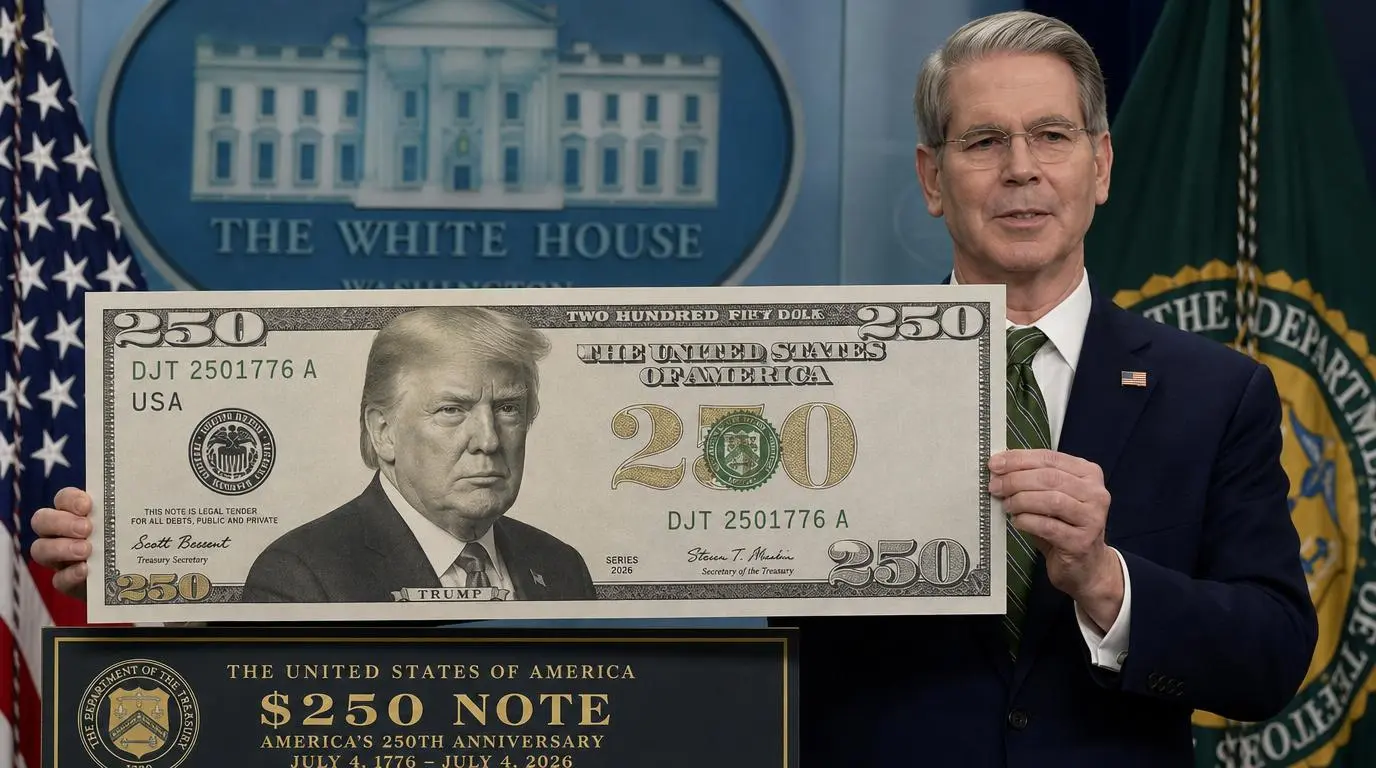
Trump $250 bill 2026 is the most shocking proposal in American monetary history. On May 28, Treasury Secretary Scott Bessent walked into the White House briefing room, held up a piece of paper showing a mock-up of a $250 bill bearing President Donald Trump’s glowering portrait, and announced that the Treasury Department had already prepared the design — waiting only for Congress to pass legislation making it legal. The room went quiet. Then the questions started.
The Trump $250 bill 2026 proposal breaks a 160-year-old federal law. It would make Trump the first living American to appear on US currency since the practice was banned by Congress in 1866. And it is happening as millions of Americans struggle to afford gas and groceries — a contrast that critics have not let go unnoticed.
What the Law Actually Says — and Why It Matters
The Trump $250 bill 2026 design did not emerge from nowhere. Last year, Rep. Joe Wilson (R-SC) introduced the “Donald J. Trump $250 Bill Act,” which was referred to the House Financial Services Committee. A GOP aide told NBC News the bill has been greenlit for a committee hearing. If it passes, it would create an entirely new denomination of US currency — $250 — and place Trump’s face on it.
The catch: federal law currently prohibits living people from appearing on US currency. This ban has been in place since 1866, when Congress passed legislation specifically to prevent the kind of monarchical personality cult that the Founders had rejected. As Bessent explained at the briefing, he has “two mandates” as Treasury Secretary: “No living person can be on US currency, and the currency must say ‘In God We Trust.'” The proposed legislation would change the first requirement — specifically, and solely, for Donald J. Trump.
“Change the first requirement so that a living person, Donald J. Trump, could be on a $250 bill,” Bessent said, repeating the president’s full name emphatically — the same way Trump himself often refers to himself in the third person.
George Washington Said No. Trump Said Yes.
The historical irony of the Trump $250 bill 2026 proposal is not subtle. George Washington — the man whose face appears on the $1 bill — famously refused to be featured on currency during his lifetime because he believed it would reflect monarchical values incompatible with the new republic he had helped create. That principle guided American monetary tradition for nearly 250 years.
It was that same attitude that lawmakers embraced in 1866 when they approved a proposal banning living people from US currency. The ban was not an accident. It was a deliberate statement about the kind of country America intended to be: one where power derived from the people, not from the cult of personality around a single leader.
Critics of the Trump $250 bill 2026 proposal have made this argument forcefully. “We’re a country, not an authoritarian personality cult,” wrote one prominent commentator. “George Washington famously declined to be featured on currency, not because he was shy, but because he thought it would reflect monarchical values.”
Bessent’s Defense: Preparation, Not Push
At the White House briefing, Bessent insisted that the Treasury was simply being prudent. “At Treasury we prepare things in advance, so we have prepared in advance that if the legislation is passed — but we will stick to the law,” he said.
Northeastern University experts questioned both the likelihood that Congress would approve such legislation and the precedent it would set. The design itself, according to the Washington Post, features Trump’s presidential portrait — the same stern, glowering image that now adorns banners hanging on some federal buildings in Washington — along with a 250th anniversary logo and Trump’s signature.
When CNN’s Kaitlan Collins pressed Bessent on why the Treasury had moved forward with designs before Congress had approved anything, his answer was simple: “You can’t draw something up the day before.”
The 250th Anniversary Angle
The Trump $250 bill 2026 proposal is being framed by its supporters as a commemoration of America’s Semiquincentennial — the 250th anniversary of the Declaration of Independence, which falls on July 4, 2026. Rep. Andy Barr (R-KY) had previously proposed a similar design, and the White House’s Freedom 250 commission has been organizing events around the anniversary for months.
“It’s so clear: this specific year, 2026, Donald Trump is the president,” said one Republican lawmaker. “What a time to show tribute to our country and to recognize the president who I believe has just been a symbol of freedom and democracy around the world.”
Supporters point to historical precedent: a half-dollar coin distributed during America’s 150th anniversary celebration in 1926 depicted then-President Calvin Coolidge alongside George Washington. Bessent cited that precedent at his briefing. Critics note that a commemorative coin and a standard denomination of US currency are very different things — and that Coolidge did not replace an existing denomination or create a new one bearing solely his image.
The $250 Denomination: Why This Number?
The choice of $250 as the new denomination is not arbitrary. It connects directly to the nation’s 250th birthday. But it also raises practical questions that economists and currency experts have begun asking.
The United States currently has $1, $2, $5, $10, $20, $50, and $100 bills in general circulation. A $250 bill would be the largest denomination in regular use since the $500 and $1,000 bills were discontinued in 1969. Large-denomination bills are primarily used for bank transfers and institutional transactions — not for everyday consumer purchases. Creating a $250 bill would have limited practical impact on the daily lives of ordinary Americans.
What it would have is symbolic impact. And in the Trump era, symbolism has frequently been the point.
What Democrats and Critics Are Saying
The reaction from Democrats and critics of the proposal has been swift and pointed. The juxtaposition of a proposal to create a $250 bill bearing Trump’s face with the ongoing affordability crisis — elevated gas prices, high grocery bills, and the economic fallout from months of conflict in the Middle East — has provided ready-made political ammunition.
When a reporter asked Bessent whether the $250 bill was a “good idea” given current consumer prices, he struggled to answer directly. The question was not just rhetorical. According to recent polling, inflation and the cost of living remain the top concerns of American voters heading into the 2026 midterms. The image of a Treasury Secretary holding up a bill with the president’s face on it while families cut back on groceries is precisely the kind of story that opposition campaigns build advertisements around.
For Republicans, the calculation is different. The Semiquincentennial provides genuine political cover, and base voters who have demonstrated enthusiasm for Trump-branded merchandise — from hats to trading cards to digital collectibles — may respond positively to seeing their preferred president on legal tender.
What Happens Next
The Trump $250 bill 2026 proposal now sits with Congress. The Donald J. Trump $250 Bill Act has been greenlit for a committee hearing in the House Financial Services Committee. Whether it advances further will depend on whether Republican leadership decides the political benefits outweigh the risks of a difficult vote in an election year.
As Bessent put it: “It’s all in the hands of Capitol Hill.”
If the legislation passes, the Treasury Department is ready. The design is done. The portrait is selected. Trump’s signature is included. All that remains is the vote — and the signature of the president whose face would appear on the bill.
That would be, in the history of American democracy, an entirely unprecedented moment. Whether it is celebrated or condemned will depend almost entirely on which side of the current political divide you stand on.
Follow all US political and economic news at TredScoop360.com. Read our coverage of Trump’s stock trades controversy and the Texas Senate race 2026 for more on the forces shaping American politics this year.
More From TredScoop360
- Panini World Cup 2026 Stickers Spark America’s Biggest Soccer Craze in History
- Trump Calls Netanyahu ‘Crazy’ in Explosive Call That Stopped Beirut Strikes in 2026
- ACM Awards 2026: Cody Johnson Wins Entertainer of the Year, Ella Langley Breaks Records