

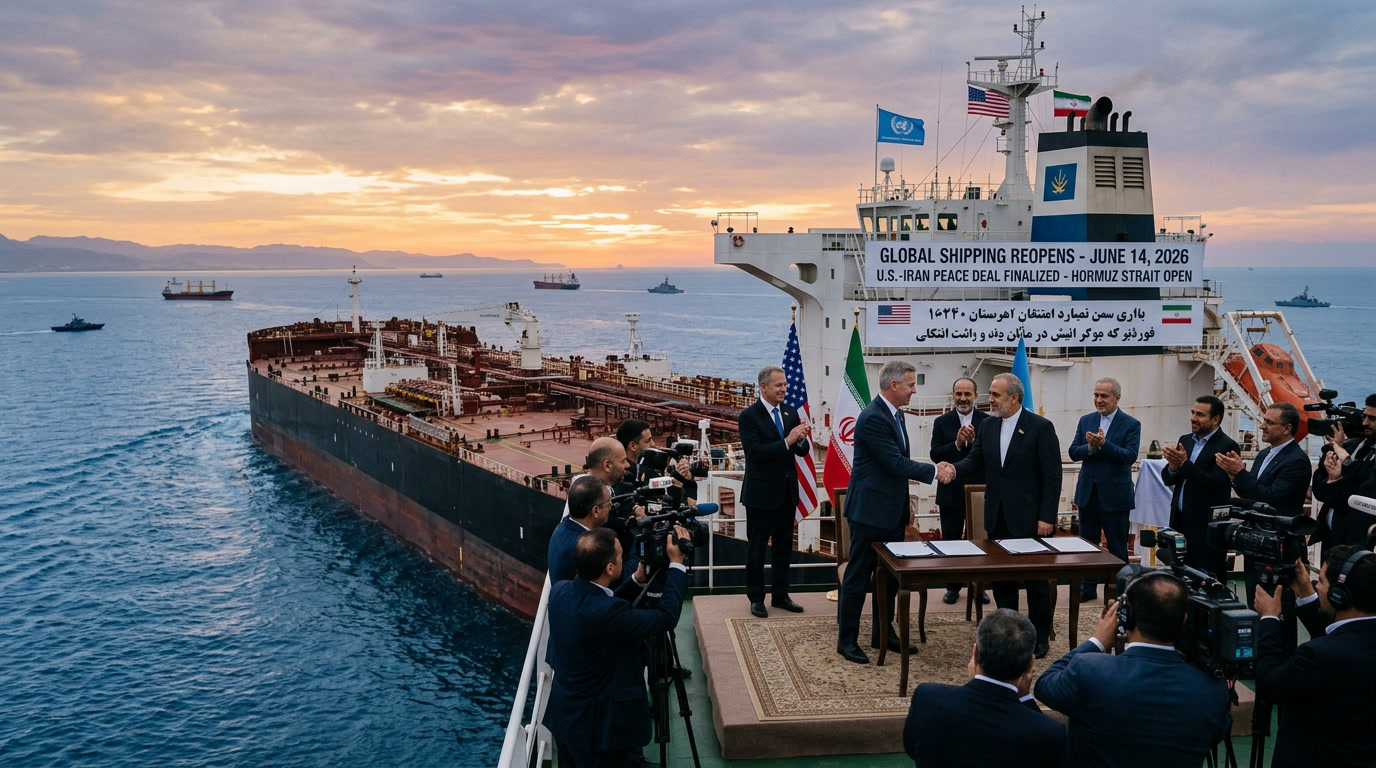
Iran deal signed June 14 2026 is no longer speculation — it is a presidential declaration posted minutes ago on Truth Social. At approximately 1:13 PM ET on Saturday, June 13, President Donald Trump posted: “The Deal is scheduled to get signed tomorrow, and immediately after it is signed, the Hormuz Strait is OPEN TO ALL.” He added: “Hopefully, this process will all work out quickly, easily, and smoothly. If it doesn’t, we have the ultimate alternative, hopefully never to be used again!”
The Iran deal signed June 14 2026 announcement came as Pakistan’s Prime Minister Shehbaz Sharif confirmed on Saturday morning that a “final, agreed-upon text” has been reached between Washington and Tehran, with the electronic signing ceremony “scheduled for tomorrow.” Oil prices dropped more than 3% within minutes of Trump’s post hitting social media.
What Trump Said — Word for Word
The Truth Social post, published Saturday afternoon, contained three historic claims packed into a few sentences. First: the deal will be signed tomorrow, June 14. Second: the Strait of Hormuz will reopen “immediately after” signing. Third: the deal includes — in Trump’s words — “A WALL TO NO NUCLEAR WEAPON,” and Iran “no longer wants a Nuclear Weapon, nor will they have one, either through purchase, development, or any other form of procurement.”
This is the most specific, time-stamped commitment Trump has made on the Iran deal since he declared “we ended the war in Iran” on Friday. The difference is significant: Friday’s statement was a rally declaration. Saturday’s Truth Social post is a public commitment to a specific date — June 14, 2026 — with a specific consequence: the Strait of Hormuz opens.
According to ABC News live updates, updated just 48 minutes ago, the signing is now formally scheduled for Sunday.
Pakistan’s Confirmation: The Final Text Is Agreed
The weight behind Trump’s declaration is significantly reinforced by Pakistan’s statement. Prime Minister Shehbaz Sharif — whose country has served as the primary diplomatic mediator between Washington and Tehran throughout the conflict — posted on X Saturday morning: “With finalisation likely expected in the next 24 hours, Pakistan is preparing for the electronic signing of the peace deal immediately after, followed by technical level talks next week.”
Sharif’s statement, confirmed by NBC News, updated just one hour ago, represents the most credible third-party confirmation yet that the deal is real, the text is agreed, and the signing ceremony is imminent. Pakistan has no incentive to fabricate or embellish — its role as mediator depends entirely on its credibility with both sides.
Trump later reposted Sharif’s remarks on Truth Social without comment — a form of implicit endorsement that the White House typically reserves for confirmations it wants to amplify.
Iran’s Mixed Signals — But Not a Rejection
Iranian Foreign Ministry spokesperson Esmaeil Baghaei introduced a note of caution Saturday afternoon, telling Iranian state media: “We will have to wait and see about the exact date of the signing of the memorandum of understanding, although it will not be tomorrow.” However, Iranian Foreign Minister Abbas Araghchi said Friday that he was hopeful a memorandum of understanding “could happen within the next one or two days, or within the next few days.”
The divergence between Baghaei’s cautious hedge and Araghchi’s optimistic framing is a classic feature of Iranian diplomatic communication — different officials calibrating different audiences. Neither statement constitutes a rejection of the deal. Both are consistent with a process that is in its final hours.
According to CBS News live updates, updated just four minutes ago, the signing “is scheduled for Sunday” with both sides in active final-stage discussions.
The 14-Point Draft: What’s Actually in the Deal
Iranian semi-official media outlet Mehr News Agency has published details of a 14-point draft memorandum being negotiated between Washington and Tehran. Key provisions reportedly include US commitments to lift oil sanctions and release Iran’s frozen assets, withdrawal of US forces from areas surrounding Iran, an end to the maritime blockade, and the reopening of the Strait of Hormuz.
The deal also reportedly requires the US and its allies to present reconstruction plans for Iran worth at least $300 billion — a figure that will face intense scrutiny in the US Senate. And at its core, it contains the nuclear non-proliferation commitment Trump described as “A WALL TO NO NUCLEAR WEAPON.”
Trump disputed some of the reported terms, stating the US would not be withdrawing forces or paying $300 billion in reconstruction aid. The final text, which has not been publicly released in full, will determine which version of events is accurate.
Oil Markets React Immediately
Wall Street and global oil markets did not wait for the formal signing. According to CBS News, oil prices sank more than 3% on Friday as Wall Street’s rebound continued into early trading. The prospect of the Strait of Hormuz reopening — and the approximately 20% of global oil supply that flows through it resuming normal transit — is already being priced into energy markets.
When a preliminary ceasefire was announced in April, Brent crude fell nearly 16% in a single session. A formal, signed deal that reopens the Strait would likely produce a sustained decline in oil prices over the coming weeks — with direct and significant consequences for American consumers at the gas pump before the July 4 holiday weekend.
What Sunday’s Signing Means for America
For the tens of millions of Americans who have been paying elevated gas prices since the Strait of Hormuz conflict began in late February, Sunday’s expected signing is the most consequential economic news of the year. Lower oil prices mean lower gas prices. Lower gas prices mean lower transportation costs. Lower transportation costs mean downward pressure on the price of almost everything Americans buy.
The Federal Reserve, which has held back on interest rate cuts partly because energy inflation kept overall price pressures elevated, could have new room to move if oil prices decline significantly and sustainably after the deal is signed.
For Trump, the timing — a peace deal signed on June 14, 2026 — delivers the economic relief the administration has been promising for months, just as the midterm campaign season begins in earnest. Flag Day. The anniversary of the US Army. The day the Strait of Hormuz reopens.
If the deal holds, it will be hard to argue with the symbolism.
Follow live updates on the US-Iran peace deal at TredScoop360.com. Read our full coverage: Trump declares war over in Iran and the explosive Trump-Netanyahu call that almost derailed these negotiations.
More From TredScoop360
- Trump Declares ‘We Ended the War in Iran’ as Shocking Deal to Reopen Strait of Hormuz Nears Signing
- World Cup 2026 Opening Day Recap: 3 Shocking Red Cards, Mexico Wins 2-0, USA Faces Paraguay Tonight
- California Governor Race 2026: Becerra vs Hilton Advance — 3 Alarming Things This Tells Us About November