

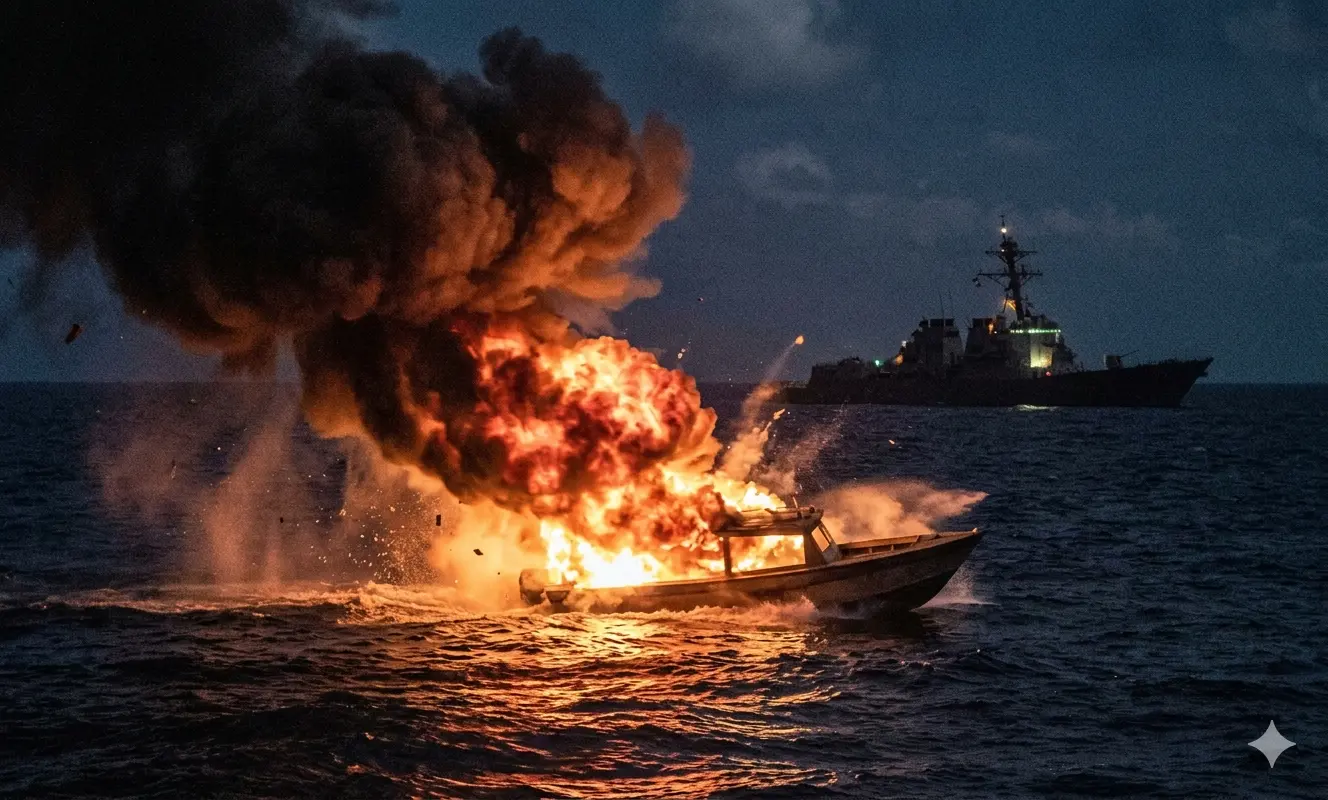
US military drug boat strikes 2026 have reached a grim new milestone. On Saturday, the fourth strike of the week in the eastern Pacific Ocean killed three more men aboard a vessel US Southern Command described as engaged in narco-trafficking operations. The total death toll from the Trump administration’s campaign against alleged drug boats now stands at 205 — and the questions surrounding it are growing louder by the day.
No evidence was provided. No arrests were made. No court approved the action. A boat was destroyed, and three more people are dead.
What Happened This Week: Four Strikes, 205 Dead
The pace of the strikes has accelerated dramatically. In a single week straddling Memorial Day weekend, the US military carried out four separate attacks on vessels in the eastern Pacific Ocean, killing a total of at least 11 people and bringing the cumulative death toll of the campaign — which began in September 2025 — to 205.
Each strike followed the same pattern. US Southern Command posted a brief statement on social media announcing that a vessel “transiting along known narco-trafficking routes” had been struck. Video was released showing a small boat in open water before being hit by an explosion and engulfed in flames. The statement noted that the vessel was “operated by a designated terrorist organization.” No further evidence was provided.
The Saturday strike alone killed three men. Earlier in the week, separate attacks killed two on Wednesday and additional casualties in prior days. The military said it notified the US Coast Guard to activate search and rescue operations for survivors — a detail that underscores the reality that people survive these strikes, at least some of the time, before being left in the open ocean.
Operation Southern Spear: What It Is and Why It Matters
The campaign has a name: Operation Southern Spear. It is run by US Southern Command under the direction of General Francis Donovan and has been a defining feature of the Trump administration’s aggressive approach to drug interdiction since it launched in September 2025.
The premise is straightforward: intercept drug-trafficking vessels in international waters in the eastern Pacific and Caribbean, identify them as operated by designated terrorist organizations, and destroy them. No boarding. No arrest. No judicial review. A missile or explosive strike, a video posted to social media, and a brief statement.
Defense Secretary Pete Hegseth has been the public face of the campaign. Earlier this week, he declared on social media that “some top cartel drug-traffickers” in the region “have decided to cease all narcotics operations INDEFINITELY due to recent (highly effective) kinetic strikes.” He provided no details or evidence to support the claim. The Pentagon and Southern Command declined to answer follow-up questions.
The Legal and Ethical Questions No One in Washington Wants to Answer
The US military drug boat strikes 2026 campaign sits in a legal gray zone that has received remarkably little scrutiny given its scale. Since September 2025, at least 205 people have been killed in these strikes — a figure that would represent a significant military operation by any measure.
Yet unlike conventional military operations, these strikes have not been authorized by a congressional declaration of war or a specific Authorization for Use of Military Force. The Trump administration has relied on existing designations of drug cartels as terrorist organizations, combined with broad executive authority, to conduct what amounts to a lethal interdiction campaign in international waters.
Prior to the campaign, countering illicit drug trafficking was handled by law enforcement agencies and the US Coast Guard. Suspects were treated as criminals with due process rights — they could be arrested, tried, and imprisoned. The shift to lethal military strikes represents a fundamental change in how the United States approaches drug interdiction, with profound implications for international law, human rights, and the rule of law at home.
Congress has raised concerns. Multiple members have sought briefings on the legal basis for the strikes. So far, the administration has provided limited information.
205 People Dead: Who Were They?
This is the question that hangs over the entire campaign, and it is one that the administration has shown little interest in answering.
US Southern Command’s statements describe the victims uniformly as “narco-terrorists” operated by designated terrorist organizations. But no evidence is provided to support these characterizations — no drug seizures, no identification of the individuals killed, no accounting of what happened to any alleged drugs that might have been aboard the vessels.
Human rights organizations have raised alarms about the lack of transparency. The campaign has killed 205 people without a single public presentation of evidence that any of them were actually engaged in drug trafficking at the time of their deaths.
The administration’s counterargument is efficiency: the campaign is working, cartel operations are being disrupted, and the alternative — a protracted law enforcement process that historically allowed traffickers to evade justice — is less effective. Whether that argument justifies the legal and ethical costs is a question that American voters, lawmakers, and courts have not yet fully confronted.
What Hegseth Says — And What He Cannot Prove
Defense Secretary Pete Hegseth has been aggressive in promoting the campaign on social media. His posts celebrate individual strikes, reference kill counts, and frame the operation as a decisive victory in the war on drugs. When he declared this week that cartels were ceasing operations “INDEFINITELY” due to the strikes, it read like a triumphant announcement.
The problem is that no independent evidence supports the claim. Drug trafficking in the eastern Pacific and Caribbean is an enormous, multi-billion-dollar industry with decades of operational history. The suggestion that a series of boat strikes — however lethal — has caused major cartel organizations to permanently cease operations stretches credulity.
What the strikes have done is shift trafficking routes and methods, according to independent analysts. Traffickers adapt. They use different vessels, different corridors, different timing. The long-term effectiveness of the campaign — and whether 205 deaths have produced any measurable reduction in drug flows to the United States — remains unproven and largely unexamined.
Memorial Day Weekend: The Timing Is Not Lost on Anyone
The fourth strike of the week occurred on Saturday of Memorial Day weekend — a holiday dedicated to honoring Americans who died in military service. The timing sharpened an already uncomfortable debate about the nature of this campaign.
Memorial Day is a moment when Americans reflect on the costs of war and the sacrifices of those in uniform. It is also, increasingly, a moment when the country grapples with what its military does in its name. Two hundred and five people dead in strikes on boats in the Pacific — people whose guilt was asserted on social media and never proven in any court — is a fact that sits uneasily alongside the solemn rituals of the holiday weekend.
For the families of those 205 people, wherever they are, there is no Memorial Day observance. There is only the absence.
What Comes Next
The campaign shows no signs of slowing. US Southern Command continues to post strike videos on social media. Pete Hegseth continues to celebrate the results. Congress continues to ask questions that go largely unanswered.
The 2026 midterm elections are six months away. Drug policy, border security, and the use of military force are all live political issues. The Trump administration’s bet is that the American public sees Operation Southern Spear as tough, effective leadership. The growing chorus of critics — including some Republicans — argues that the administration has crossed a line that cannot easily be uncrossed.
Two hundred and five people dead. No evidence presented. No trials held. No accountability offered. That is the record of the US military drug boat strikes 2026 campaign as of Memorial Day weekend. Whether it is justice, policy, or something else entirely is a question Americans will be debating long after the last boat burns.
Follow all 2026 US military and political news at TredScoop360.com. Read our coverage of the US-Iran deal and Trump’s stock trades controversy for more context on the administration’s actions.
More From TredScoop360
- PSG Win 2026 Champions League Final: Arsenal’s Heartbreak on Penalties in Budapest
- Paxton vs Talarico: The Texas Senate Race 2026 That Could Flip the Midterm Map
- Trump in the Situation Room: Will He Sign the Iran Deal and Reopen the Strait of Hormuz?