

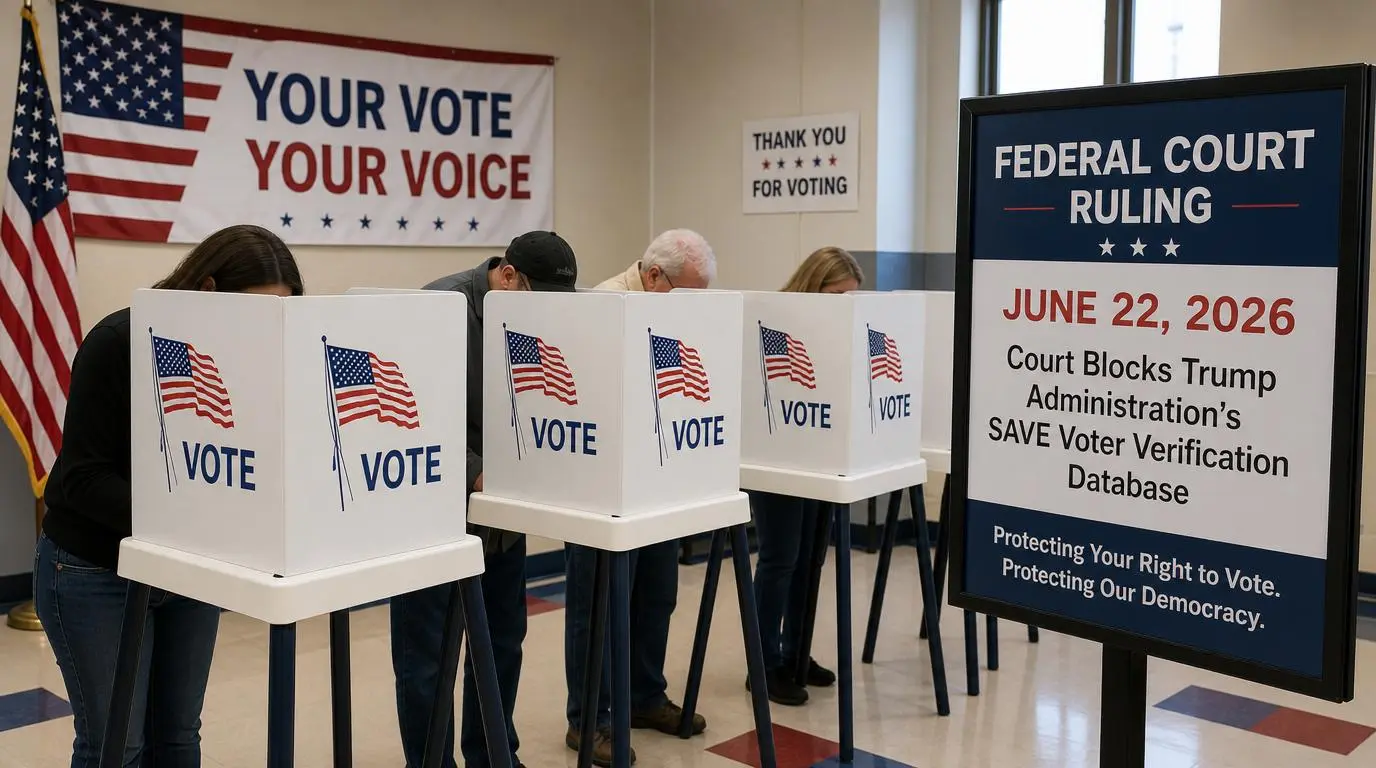
SAVE system ruled unlawful 2026 is the headline coming out of a Washington, D.C. federal courtroom that could reshape how the Trump administration approaches voter verification ahead of the November midterms. On Monday, U.S. District Court Judge Sparkle Sooknanan ruled that a sweeping overhaul of the federal government’s voter eligibility database violated three separate federal laws — and ordered that the tool, in its current form, can no longer be used by states checking their voter rolls.
The SAVE system ruled unlawful 2026 decision lands at the center of one of the most consequential ongoing fights over voting rights in the country. Tens of millions of American voters have already had their personal data run through the Trump administration’s revamped Systematic Alien Verification for Entitlements system — known as SAVE — and Monday’s ruling found that the way the government built and deployed that tool broke the law.
SAVE System Ruled Unlawful 2026: What the Judge Actually Found
In a 75-page ruling, Judge Sooknanan — a Biden appointee — did not hold back in describing what she found. “All in all, the federal government has knowingly trampled on the privacy rights of American citizens in a manner that threatens the sacred right to vote,” she wrote. “This Court cannot stand idly by while that happens.”
The ruling determined that federal agencies lacked the statutory authority to overhaul the SAVE system in the way they did, and that the changes violated the Privacy Act, the Social Security Act, and the Administrative Procedure Act — three separate federal statutes governing how government agencies can collect, combine, and use Americans’ personal data.
SAVE itself is not new. The system has existed since 1986 as a tool to verify immigration status for benefits eligibility. What changed under the Trump administration was its scope and purpose. Last year, the Department of Homeland Security — with assistance from the Department of Government Efficiency, known as DOGE — enabled bulk checks on the system for the first time. Further modifications linked SAVE to Social Security Administration records and, critically, added the records of American-born citizens to a database that had previously focused on noncitizens.
According to Sooknanan’s ruling, this overhaul meant federal agencies “haphazardly combined and repurposed the private information of millions of Americans, including citizenship data that they knew to be unreliable.”
The Real-World Harm: Citizens Wrongly Flagged
The SAVE system ruled unlawful 2026 case is not an abstract legal dispute about data governance. According to court filings and reporting, the practical consequence of the SAVE overhaul was that a number of American citizens — particularly those born outside the United States — were mistakenly flagged as potential noncitizens by the system.
Several states had already run their entire voter registration lists through the modified SAVE database before Monday’s ruling, and some had used the flawed results to remove individuals from their voter rolls. For citizens who were naturalized, or who were simply foreign-born US citizens, being incorrectly tagged as a noncitizen and purged from voter rolls represents a direct, tangible harm to their constitutional right to vote.
NPR was the first news outlet to report on the federal government’s expansion of SAVE into a tool designed to check the citizenship status of all registered voters nationwide — reporting that ultimately formed part of the factual record underlying Monday’s lawsuit.
Who Sued — and Why
The SAVE system ruled unlawful 2026 lawsuit was brought by the League of Women Voters, the Electronic Privacy Information Center, and five individual plaintiffs against the Department of Homeland Security, the Social Security Administration, and the Department of Justice. The plaintiffs argued that consolidating Americans’ sensitive records across multiple federal agencies — without proper legal authority or adequate safeguards — was unlawful on its face, separate from any question of how the resulting data was later used.
“Today’s decision is a resounding victory for voters,” said Marcia Johnson of the League of Women Voters, one of the organizations behind the suit. “Efforts to create a federal voter database to facilitate voter purges threaten the fundamental right at the heart of our democracy.”
Skye Perryman, president and CEO of Democracy Forward, framed the ruling in similarly stark terms: “The data at the heart of this lawsuit was unlawfully consolidated in violation of privacy laws intended to protect sensitive personal information.”
Nikhel Sus, a lawyer with Citizens for Responsibility and Ethics in Washington, which also represented plaintiffs in the case, pointed to a deeper pattern of the administration ignoring public input. After the lawsuit was filed challenging the SAVE overhaul, DHS and the Social Security Administration retroactively issued public notices about changes that had already been implemented. Those notices drew tens of thousands of negative public comments, but the agencies proceeded with their plans regardless. “They just didn’t listen to the American people who spoke out against this plan,” Sus said.
How This Connects to Trump’s Broader Voting Agenda
The SAVE system ruled unlawful 2026 ruling does not exist in isolation — it strikes at a central pillar of the Trump administration’s approach to election integrity. On March 31, 2026, President Trump signed an executive order directing the Department of Homeland Security to use SAVE and other federal databases to generate a list of eligible US voters, despite research and state-level reviews consistently finding that voting by noncitizens is exceedingly rare under existing law, which already prohibits it.
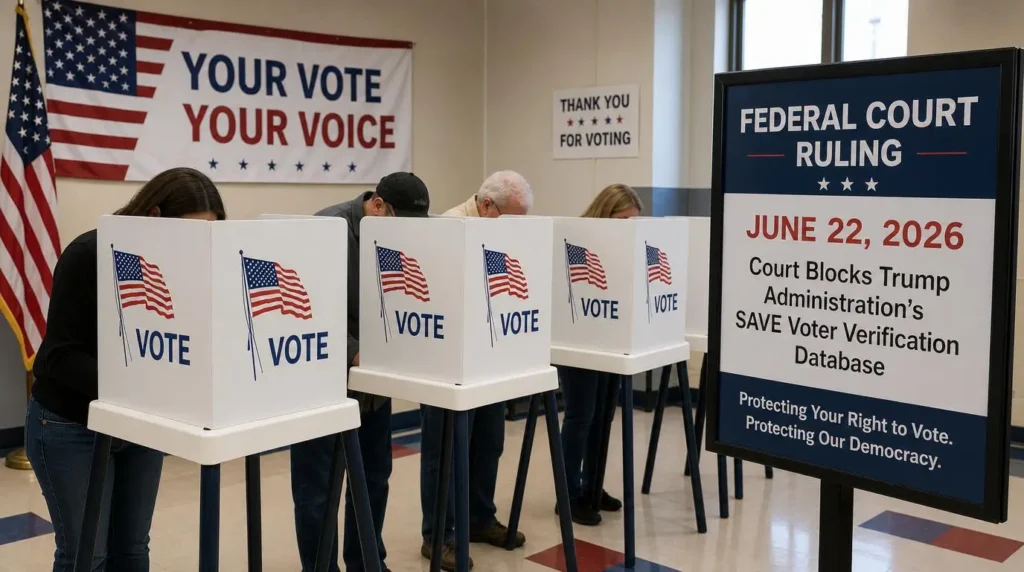
The administration has defended its expansion of SAVE as fulfilling “a clear congressional directive to break down information silos between government agencies,” arguing that DHS possessed the authority to modernize the decades-old database. The Justice Department, representing DHS in the litigation, signaled it would continue defending the policy: “The Department will continue to aggressively defend President Trump’s immigration enforcement agenda and DHS’s use of the SAVE system to verify citizenship,” the DOJ said in a statement following the ruling.
The White House Response: Sharp and Defiant
The Trump administration’s public reaction to the SAVE system ruled unlawful 2026 decision was immediate and combative. A Department of Homeland Security spokesperson responded by pointing to a social media post from the department’s general counsel, James Percival, who wrote: “It’s amazing how hard the Left will fight to stop us from solving problems they insist do not exist. Judge Sparkle Soknanan’s latest ruling preventing DHS from addressing alien voting is just the latest example!” — a post that misspelled the judge’s name.
The federal government retains the right to appeal Sooknanan’s ruling, and given the administration’s consistent posture on immigration enforcement and election integrity throughout 2026, an appeal appears likely. For now, however, the modified SAVE system cannot be used by states or federal agencies in its current overhauled form.
What Happens Next for the 2026 Midterms
The timing of the SAVE system ruled unlawful 2026 decision is significant. With November’s midterm elections less than five months away, the ruling effectively removes a tool the administration had positioned as central to its voter eligibility verification strategy heading into the cycle.
States that had already begun incorporating SAVE checks into their voter roll maintenance processes will need to reassess those procedures in light of Monday’s order. Voting rights advocates worry that without judicial intervention, the Department of Homeland Security could have become, in the words of one advocate, “not a partner helping to secure elections, but rather a threat seeking to undermine results that President Trump dislikes.”
For millions of foreign-born American citizens who use the franchise like any other voter, the ruling offers a measure of protection against being wrongly removed from voter rolls based on an unreliable data system. Whether that protection survives an expected appeal — and whether Congress responds with new legislation explicitly authorizing or restricting this kind of data consolidation — will be among the most closely watched legal and political storylines of the 2026 election cycle.
Follow all breaking US political and legal news at TredScoop360.com. Read our coverage of the Texas Senate race 2026 and the California governor race 2026 for more on the issues shaping this year’s midterm elections.
More From TredScoop360
- Iran Talks Collapse in Switzerland 2026: Trump Threatens to ‘Hit Iran Very Hard Again’ as Delegation Walks Out
- Vance Iran Deal 2026: VP Defends ‘Win-Win’ MOU as GOP Hawks and Carville Both Cry Foul
- Supreme Court Rules 9-0: Marijuana Users Can Own Guns in Shocking 2nd Amendment Victory — US v. Hemani