

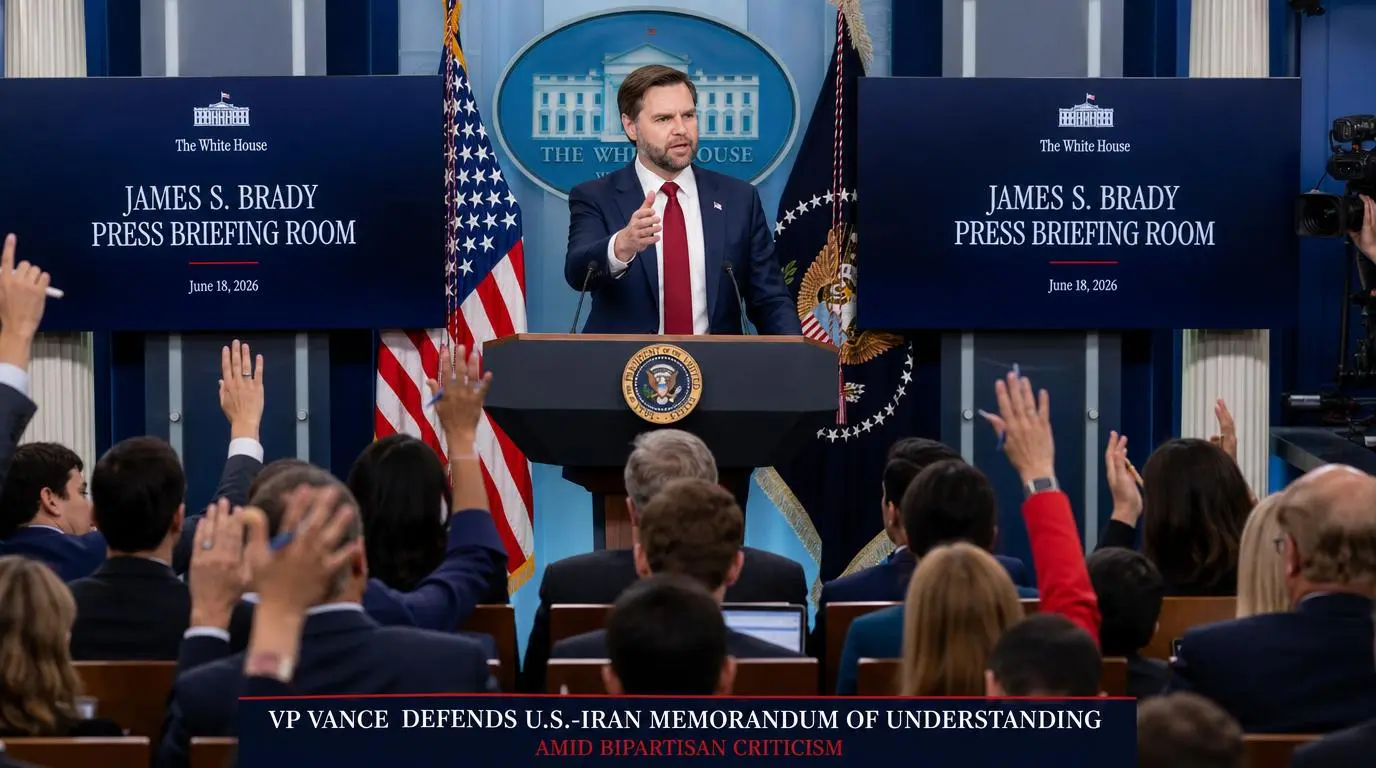
Vance Iran deal 2026 has become the most contested foreign policy story in Washington this week, as Vice President JD Vance mounts an aggressive public defense of the US-Iran memorandum of understanding against criticism from an unusually bipartisan coalition — Republican hawks who say it gives away too much, and Democratic critics who say the entire war was a costly failure.
Standing at the podium in the White House press briefing room on Thursday, Vance delivered his most combative performance yet defending the agreement that President Trump signed with Iranian President Pezeshkian earlier in the week while dining at the Palace of Versailles with French President Macron. His central argument: America wins either way, regardless of whether Iran ultimately complies.
Vance Iran Deal 2026: The “Win-Win” Argument
At the heart of Vance’s defense is a framing built around inevitability. “If the Iranians don’t change their behavior, their military and their nuclear program is still destroyed,” Vance told reporters. “If they do change their behavior, then they are going to have a transformative relationship with the Middle East, and the Middle East will have a transformative relationship with the people of Iran.”
Vance pointed to concrete, measurable evidence that the deal is already producing results. Oil has begun moving through the Strait of Hormuz again after months of disruption, and gas prices in the United States have ticked below $4 per gallon for the first time since the conflict began in late February. For an administration eager to demonstrate tangible wins ahead of the November midterms, those numbers carry significant political weight.
“With oil markets recovering, gas prices ticking below $4, and Republican critics on Capitol Hill raising alarms,” the briefing built around a single core argument, according to detailed coverage of the event: the United States holds all the leverage, and the deal — whatever its imperfections — is structured so that America benefits under any scenario.
The Deal Itself: What’s Actually in the MOU
The memorandum of understanding, signed separately by each country on Wednesday after a planned joint signing ceremony was scrapped, launched a 60-day negotiating period focused on Iran’s nuclear program and other outstanding disputes. According to Al Jazeera’s reporting, the agreement opens the Strait of Hormuz, lifts the US naval blockade of Iranian ports, and pledges to end fighting on all fronts, including in Lebanon.
The deal arrives 112 days into a war that began on February 28, 2026, when the United States and Israel launched a joint military campaign against Iran’s nuclear infrastructure. Assessments of the strike results remain mixed: the above-ground enrichment facility at Natanz was destroyed, but the deeply buried Fordow enrichment facility sustained only an estimated 30% damage, with its core potentially intact. Because Iran expelled IAEA inspectors on the day the war began, no independent verification of Iran’s remaining nuclear capability has been possible.
Iran’s Supreme Leader Mojtaba Khamenei, who succeeded his predecessor earlier this year, has reportedly approved the MOU in a written statement — though he was careful to note that engaging in talks with the United States does “not mean accepting its views.”
GOP Hawks Revolt: “Negotiates Away the Victories”
The most politically uncomfortable element of the Vance Iran deal 2026 controversy is that some of the sharpest criticism is coming from within the Republican Party itself. Senator Roger Wicker, chair of the Senate Armed Services Committee, complained publicly that the MOU “negotiates away the victories” accomplished by the US military during the war.
Several other Republican lawmakers and a larger number of prominent conservative commentators have echoed that complaint, with the common theme being that the agreement is too soft on Iran and does too little to protect American and Israeli interests. Critics specifically point to the immediate waiver of sanctions on Iranian oil exports as a concession that came too easily, without sufficient guarantees of changed Iranian behavior in return.
Vance’s response to these critics has been pointed. “The idea that they get benefits before they change their behavior is fundamentally a talking point that is issued by people who want the conflict to continue indefinitely,” he said at the briefing — a direct shot at members of his own party.
Carville’s Blunt Take: “You Just Lost a War”
On the other side of the political spectrum, Democratic strategist James Carville offered perhaps the most viral and brutal characterization of the deal: “Happy 250th America. You just lost a war.”
Senate Minority Leader Chuck Schumer was similarly unsparing, saying the United States is “worse off because of Trump’s incompetence, his ego, and his inability to listen to facts.” Schumer also rejected suggestions that Democrats would support any funding tied to the deal, stating flatly: “Democrats will not be helping Trump send $300 billion to Iran.”
That $300 billion figure has become a flashpoint of its own. Critics of the memorandum allege it includes a $300 billion reconstruction package for Iran, but Trump and senior administration officials deny that any US funds will be directly provided, insisting that any investment in Iran’s reconstruction would come from its neighbors and other regional participants rather than the American taxpayer.
Israel’s Uneasy Position
Perhaps the most diplomatically sensitive thread running through the Vance Iran deal 2026 story is the visible strain it has placed on the US-Israel relationship. Vance told Israel directly that it “can’t kill your way out” of its regional security problems — a remarkably blunt statement for an American vice president to make about a key ally, even as he affirmed Israel’s right to defend itself.
According to the Times of Israel, a recent poll found that only a small fraction of Israelis believe their country won the war against Iran, and most feel that Prime Minister Benjamin Netanyahu’s conduct actually hurt Israel’s interests in the resulting agreement. That represents a striking departure from the consistently strong support Israeli polling has shown for Trump throughout his presidency.
Vance also reserved some of his sharpest criticism for Israeli far-right ministers Bezalel Smotrich and Itamar Ben-Gvir, who have publicly attacked the deal — a sign that the rift between Washington and elements of the Israeli government runs deeper than typical diplomatic friction.
What Happens Next: 60 Days and a Trip to Switzerland
The 60-day negotiating clock that began Thursday will determine whether the interim memorandum becomes a lasting framework or collapses under the weight of the criticism from both flanks. Vance had been scheduled to travel to Switzerland to launch the next round of formal talks with Iranian negotiators, but the trip was delayed at the last minute following an overnight Israeli bombing in southern Lebanon that killed at least three people — a reminder of how fragile the broader ceasefire arrangement remains.
Iran’s semi-official Tasnim news agency reported that Iranian negotiators have not confirmed they will travel for the talks, indicating Tehran wants to see concrete signs that the interim agreement — which also covers a ceasefire in Lebanon — is actually being implemented before committing further.
The Bottom Line for American Voters
For ordinary Americans, the Vance Iran deal 2026 debate ultimately comes down to a simple question: is the country better off than it was 112 days ago? Gas prices below $4 a gallon and oil flowing freely through Hormuz again are concrete, measurable improvements that touch nearly every American household.
Whether that economic relief outweighs concerns about an incompletely destroyed Iranian nuclear program, a strained relationship with Israel, and a deal that satisfies neither GOP hawks nor Democratic critics will likely be debated all the way to the November midterms — and possibly well beyond.
Follow all breaking US foreign policy news at TredScoop360.com. Read our earlier coverage of Trump declaring the Iran war over and the explosive Trump-Netanyahu phone call for the full story behind this week’s developments.
More From TredScoop360
- Supreme Court Rules 9-0: Marijuana Users Can Own Guns in Shocking 2nd Amendment Victory — US v. Hemani
- Laredo Texas Plane Crash 2026: Bystanders Use Sledgehammer to Save Trapped Passengers, 1 Dead
- B-52 Bomber Crashes at Edwards Air Force Base 2026: 8 Dead in Deadliest US Military Crash Since 1982