

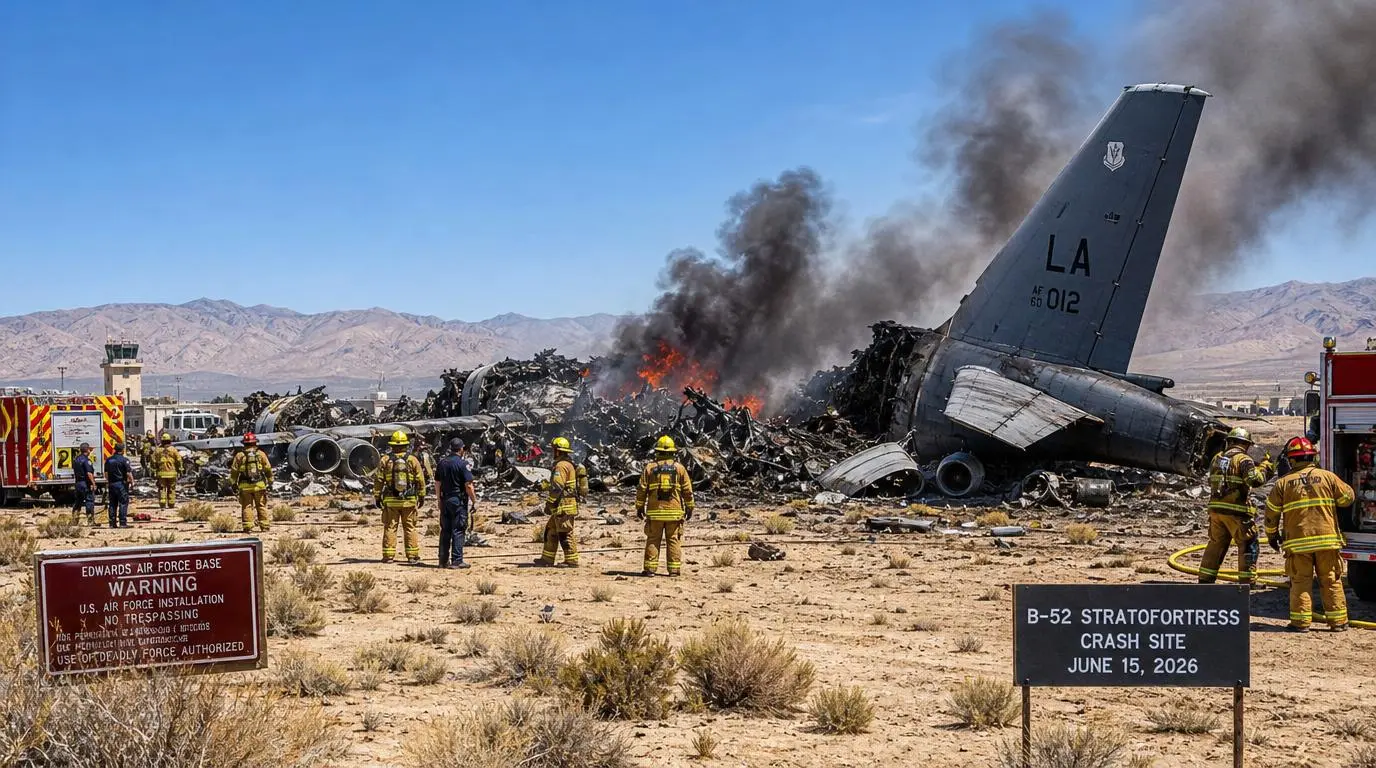
B-52 bomber crash Edwards Air Force Base 2026 has killed all eight people on board in the deadliest incident involving America’s iconic long-range bomber since 1982. At approximately 11:20 a.m. local time on Monday, June 15, a Boeing B-52 Stratofortress crashed shortly after takeoff from Edwards Air Force Base in California’s Mojave Desert, burst into flames, and left wreckage so badly burned that aerial footage showed almost nothing recognizable of the aircraft. There were no survivors.
The B-52 bomber crash Edwards Air Force Base 2026 claimed the lives of a mixed crew of military servicemembers, government civilians, and private contractors — including two employees of Boeing, the aircraft’s manufacturer. The crash occurred during what the Air Force described as a “routine test mission” for a radar modernization program. It is the worst B-52 disaster in more than four decades, and it sent a towering black plume of smoke into the Southern California sky visible for miles.
B-52 Bomber Crash Edwards Air Force Base 2026: What We Know
The sequence of events was swift and catastrophic. The B-52 Stratofortress departed Edwards Air Force Base at approximately 11:20 a.m. Pacific time. Moments after takeoff, something went wrong. The aircraft plunged back to the ground while still on or near the base’s property in the Mojave Desert, struck the earth, and caught fire immediately.
Aerial footage captured by ALERTCalifornia cameras — part of the state’s wildfire detection network — showed massive billowing smoke and flames rising from the crash site. Cal Fire and local emergency responders raced to the scene, but initial indications from base officials were grim. “Initial indications are that the crash was not survivable,” Edwards Air Force Base said in its first public statement.
At an afternoon news conference, Colonel James Hayes, deputy commander of the 412th Test Wing at Edwards, confirmed what the footage already suggested: all eight people aboard were dead.
“Today, Edwards Air Force Base experienced a terrible tragedy and we lost eight great Americans,” Hayes said, his voice steady but the weight of the moment unmistakable. He confirmed that officials were working to notify the families of those killed before releasing their identities publicly.
Who Was on Board
The crew of the crashed B-52 was not a standard operational crew. This aircraft was carrying a test mission team — a combination of active-duty Air Force personnel, government civilians, and private-sector contractors from Boeing working on a radar modernization program.
Boeing confirmed that two of its employees were among the eight killed. “We are in contact with their families and are offering support,” Boeing said in a statement released Monday afternoon. Boeing manufactures the B-52 Stratofortress and has been involved in a multi-year program to update the bomber’s radar systems with a modern active electronically scanned array — known as AESA radar — to replace the aircraft’s aging original equipment.
The specific identities of all eight victims were not publicly released as of Monday evening, pending notification of all next of kin. Colonel Hayes said that process was ongoing.
The Aircraft: A Legend That Has Served for 70 Years
The Boeing B-52 Stratofortress is one of the most recognizable aircraft in American military history. It entered service in 1955 — making the airframe now over 70 years old in design, though individual aircraft have been extensively modernized. Originally designed to carry nuclear weapons on long-range deterrence missions during the Cold War, it has served in virtually every major US military conflict since Vietnam.
According to Al Jazeera’s coverage, updated two hours ago, approximately 76 B-52s remain in active service with the US Air Force. The aircraft is capable of carrying up to 32,000 kilograms of weapons, flying for approximately 8,700 miles without refueling, and reaching high subsonic speeds. It is known, paradoxically, for its low maintenance requirements relative to its performance capabilities.
The crash of Monday is the deadliest involving a B-52 since 1982. The previous major B-52 disaster in recent memory was the 1994 Fairchild Air Force Base crash in Washington State, which killed four crew members when a pilot’s aggressive maneuvers during an airshow practice caused the aircraft to stall and roll into the ground.
The Radar Modernization Program: What the Test Was For
The specific mission being conducted when Monday’s crash occurred was a test flight related to the B-52’s radar modernization program. According to CBC News, updated 11 hours ago, in 2025 a B-52 flew to Edwards Air Force Base equipped with a new modernized AESA radar system. A test team was assigned to conduct ground and flight test activities throughout 2026 to inform a production decision on whether to equip all operational B-52s with the new radar.
It is unclear whether the aircraft that crashed Monday was the same B-52 involved in the 2025 radar installation, though the description of the mission as a radar modernization test is consistent with that program. The Air Force did not confirm or deny the connection at Monday’s news conference.
The AESA radar upgrade is part of a broader B-52 modernization effort known as the B-52J program, which is intended to keep the bomber operationally relevant well into the 2050s — potentially making it the longest-serving combat aircraft in history. Monday’s crash will inevitably raise questions about the safety protocols governing the test program.
Pentagon and Defense Secretary Respond
Defense Secretary Pete Hegseth responded to the crash on social media within hours of the news breaking. “May GOD shepherd the souls of these incredible Americans — and watch over their families,” Hegseth wrote on X.
The Pentagon confirmed it was aware of the incident and deferred to Edwards Air Force Base for details on the investigation. Air Force officials said the investigation process can take upwards of six months, and that no information about the cause of the crash would be available in the near term.
“We won’t be able to release that information, and we don’t have an ability to get that any time soon,” Hayes said at Monday’s news conference, referring to a probable cause determination.
Historical Context: The Most Dangerous Day for the B-52 Since 1982
Monday’s crash represents the single worst day for the B-52 fleet since a crash in 1982. The aircraft’s remarkable safety record over the past four decades makes Monday’s event particularly jarring for the Air Force community.
The B-52 has accumulated millions of flight hours over its operational life, and its loss rate in non-combat operations has been extraordinarily low in recent decades. The combination of the aircraft’s iconic status, the test mission context, the Boeing employees among the dead, and the dramatic footage of the smoke rising over the Mojave Desert has made this story one of the most widely covered military accidents in recent American memory.
According to CNN’s coverage, updated just two hours ago, the crash “sent a towering black plume of smoke into the Southern California sky” visible from miles away, and the wreckage was described as “charred and barely recognizable.”
For Edwards Air Force Base — the home of American flight test operations since Chuck Yeager broke the sound barrier there in 1947 — Monday was the darkest day in recent memory. The base has seen historic achievements and tragic losses over its 79 years. This one will be remembered.
Follow all breaking US military and national news at TredScoop360.com. Read our coverage of the Missouri skydiving plane crash and the US-Iran peace deal for more of America’s most important stories this week.
More From TredScoop360
- Missouri Skydiving Plane Crash 2026: 12 Killed Near Butler Airport — NTSB Investigates
- Knicks Are 2026 NBA Champions: Brunson Scores 45 in Game 5 to End New York’s 53-Year Drought
- Iran Deal Signing Tomorrow June 14: Trump Says Hormuz ‘OPEN TO ALL’ as Pakistan Confirms Final Text